The standard deduction and itemizing are two subtractions from the same number — adjusted gross income — before the tax is figured. They are not stacked. For one tax year, Form 1040 keeps a single amount on that line. The published standard deduction is the floor under the line for people who may use it. Itemizing is a Schedule A total that replaces the floor only when the list is larger, or when the floor is not allowed at all.

Treat the next figures as a labeled 2025 example, not a filing position. Filing status is single. The person is not a dependent, not 65, not blind. Line 11b shows $72,000 of adjusted gross income. Both paths start there. A tax deduction still cuts income, not the tax itself. This fork is which cut.
Same year, two columns
The left column is the standard path. The 2025 Form 1040 prints the basic amounts beside line 12e: $15,750 for single or married filing separately, $31,500 for married filing jointly or qualifying surviving spouse, $23,625 for head of household. Those are the figures in Revenue Procedure 2025-32, as of October 9, 2025, and they match the 2025 Form 1040 instructions. The left column writes $15,750 on line 12e. Income subject to tax, before any qualified business income deduction, is $56,250.

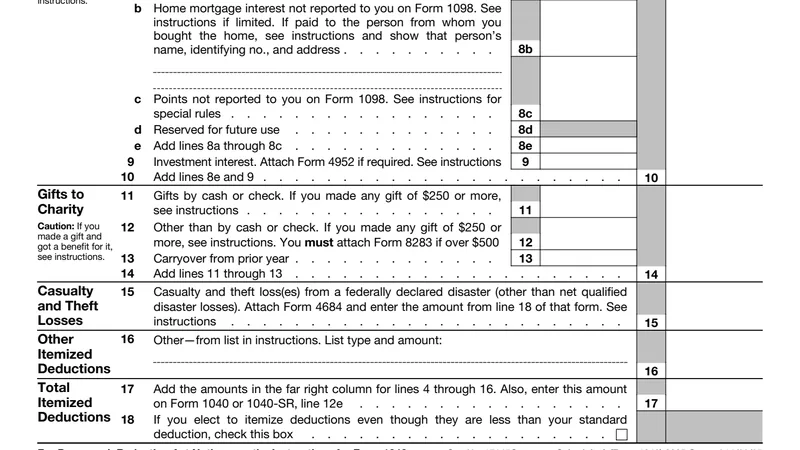
The right column is the same person, same year, same $72,000, filling Schedule A. That form is a list — certain medical expenses only above 7.5 percent of AGI, certain state and local taxes, home mortgage interest, charitable gifts, and a short set of other named items. Each category has its own floor or cap. The list’s total is Schedule A line 17.
Give the list two labeled totals. First: $9,000 of state and local taxes, $4,500 of mortgage interest, $1,200 of gifts — $14,700. Smaller than $15,750. The return that takes the larger number writes $15,750 on line 12e. The $14,700 does not ride along. Second: $9,000, $8,200, and $2,100 — $19,300. Larger than $15,750. Line 12e becomes $19,300. Income subject to tax is $52,700. The $15,750 is gone. It was never a bonus on top of the list.
The 2025 instructions say the tax is usually smaller if the larger number is used. Software compares. A paper return looks at the printed amounts and at Schedule A line 17. Age and blindness raise the floor; they do not add a second subtraction. For 2025, a single filer who checks one box on line 12d — born before January 2, 1961, or blind — uses $17,750. Two boxes: $19,750.
Where Form 1040 keeps one number
The choice is not a mood. It is line 12e.
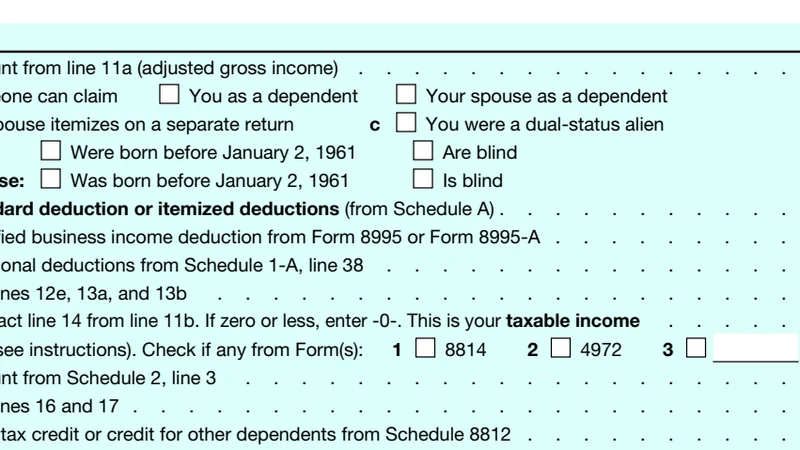
Lines 12a through 12d change what 12e is allowed to be. A dependent checkbox on 12a sends the return to a worksheet: the 2025 floor is the smaller of the basic amount or the greater of $1,350 and earned income plus $450. If a spouse itemizes on a separate return, 12b sets the standard deduction to zero. A dual-status alien on 12c gets the same zero. Those zeros are why some people must itemize — along with a short-year return after a change in accounting period, and an estate, trust, common trust fund, or partnership.
Schedule A line 17 is the itemized total, entered on Form 1040 line 12e. Line 18 is a checkbox for electing to itemize even when the list is smaller. The ordinary machine does not use that box. It writes the larger number on 12e and stops. Deductions that come off before AGI, and the 2025 amounts the instructions put on Schedule 1-A, sit on other lines. They can apply on either path. They are still not credits.

For tax year 2026 — returns filed in 2027 — the same revenue procedure raises the basic floor to $16,100 single or married filing separately, $32,200 joint or surviving spouse, and $24,150 head of household. The extra amount for age or blindness becomes $1,650, or $2,050 if the person is also unmarried and not a surviving spouse. The fork does not change. The printed numbers do.
A floor, not a tip
People talk about “getting the standard deduction” as if Congress handed out a gratuity, then let itemizers keep their receipts on top. The form does not work that way. The standard deduction is a minimum subtraction from AGI for people who may use it. Itemizing is a competing subtraction built from named expenses. Line 12e holds one of them.

A $3,000 charitable gift does not raise a $15,750 standard deduction to $18,750. The gift lives on Schedule A. It only changes the tax if the whole list beats the floor — or if the filer had to itemize anyway. A year of small deductible expenses can be real and still produce the same line 12e as a year with none. The floor was already there.
Confirm the current Form 1040, Schedule A, and published amounts at the IRS. This is a description of the return, not a filing position.