A Form W-2 is an employer’s wage-and-tax statement. A Form 1099 is a payer’s information return for money that was not treated as those wages. The W-2 already shows federal income tax — and Social Security and Medicare tax — taken from the paycheck. The common 1099s usually do not. The same dollars can still be income. They just arrive on different Form 1040 lines, with different amounts already sitting at the Treasury.

Follow one person. Same year. Two machines.
Two envelopes, one person
In January the mail is not a mood. It is a filing.
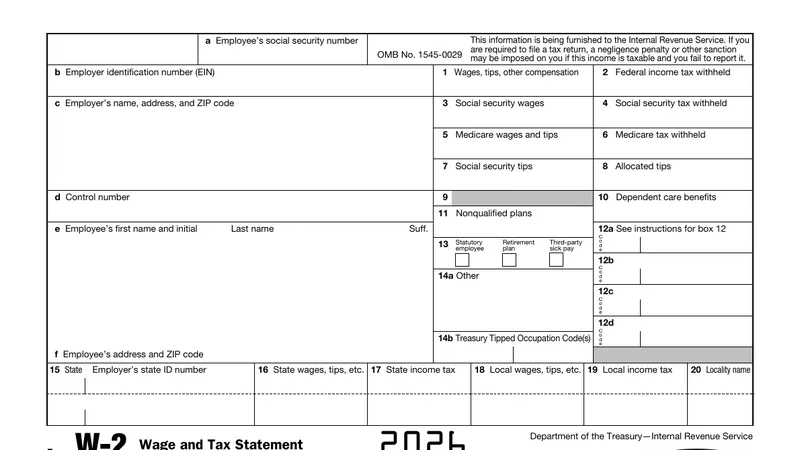
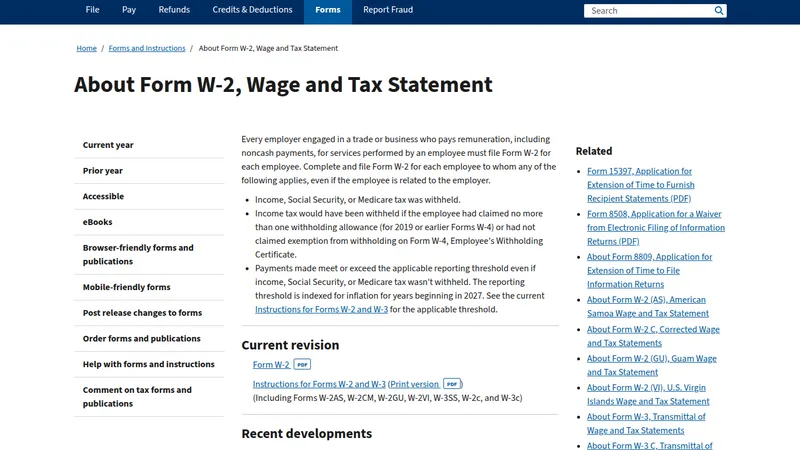
The employer sends Form W-2, Wage and Tax Statement. The 2026 instructions are blunt: if you had employees you paid for services in your trade or business, you file Form W-2. Copy A goes to the Social Security Administration. Copies B, C, and 2 go to the employee by February 1, 2027, for calendar year 2026. Box 1 is wages, tips, other compensation. Box 2 is federal income tax withheld. Boxes 3 through 6 are the Social Security and Medicare wage bases and the tax already taken.
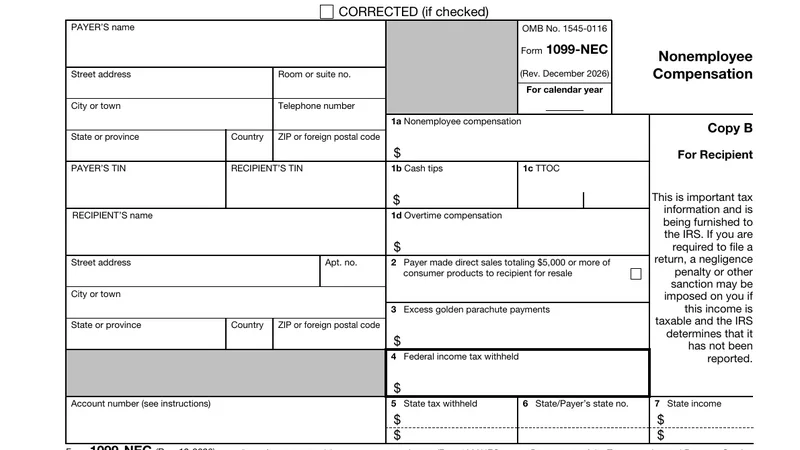
A client who paid for work, and who did not treat the person as an employee, sends a different form. Form 1099-NEC, Nonemployee Compensation. For 2026 the instructions set the usual reporting floor at $2,000 of services paid in the course of the payer’s trade or business to someone who is not an employee — or any amount if backup withholding was taken. Box 1a is the compensation. Box 4 is federal income tax withheld, when there is any. The payer files that form with the IRS, not with the SSA, and furnishes the recipient copy by January 31.
A bank or credit union that credited taxable interest sends Form 1099-INT. The usual floor for deposit interest is $10. Box 1 is the interest. Box 4, again, is federal income tax withheld — only if backup withholding applied.
The person is the same. The dollars may have landed in the same account. The forms are not interchangeable. Wages, bonuses, and awards paid to an employee go on the W-2. The 1099-NEC instructions say so in a list of exceptions.
This is not a classification lesson. The form follows the relationship the payer treated. If that treatment was wrong, the IRS has a different machine for that. This article is about what the two information returns actually report.
Two withholding machines
The payroll machine subtracts before the employee ever holds the dollars. Paycheck withholding is that subtraction: income tax under the payroll tables, plus Social Security tax and Medicare tax under Circular E. The employer remits those amounts in the employee’s name. The W-2 is the annual receipt. Box 2 is the income-tax slice. Boxes 4 and 6 are the FICA slices. The employer’s own share of Social Security and Medicare never appears as a credit on the employee’s Form 1040. It was never the employee’s money.
The information-return machine is a report, not a paycheck slice. A 1099-NEC or 1099-INT tells the IRS — and the recipient — that a payment was made. It does not, by itself, send income tax to the Treasury. Backup withholding is the exception, not the default: the general instructions for information returns put the rate at 24 percent when the payee has not furnished a taxpayer identification number in the required way, or when the IRS has said to withhold. That amount, if any, lands in box 4. It is still not Social Security or Medicare withholding. The 1099-NEC instructions say amounts in box 1a are generally subject to self-employment tax. That tax is figured later, on Schedule SE. The payer did not take the worker’s half and pay an employer’s half. There was no half.
Interest on the 1099-INT is not wages and is not self-employment income. It is interest. The bank did not run a payroll. Unless box 4 has a number, nothing was withheld.
Income a paycheck did not slice is why estimated tax exists. That is the other pipe. This article is not that pipe.
A 1099-MISC is a third sibling, not a fourth withholding machine. For 2026 it is the form for rents at the $2,000 floor, royalties at $10, certain prizes, and a short list of other named payments. It is still an information return. Box 4 is still backup withholding when it applies.
Same dollars, different Form 1040 lines
Treat the next figures as a labeled 2026 example, not a filing position. One person. One year.
The employer paid $40,000 of wages and issued a W-2. Box 1 is $40,000. Box 2 shows federal income tax already withheld. Boxes 4 and 6 show Social Security and Medicare tax already withheld.
A client paid $8,000 for freelance work and issued a 1099-NEC. Box 1a is $8,000. Box 4 is blank.
The bank credited $120 of taxable interest and issued a 1099-INT. Box 1 is $120. Box 4 is blank.
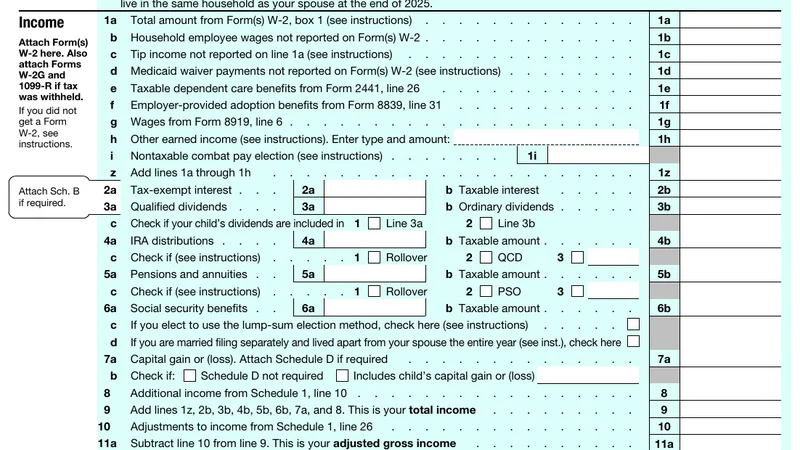
On the 2025 Form 1040 — the latest complete individual return — those three numbers do not share a line.
Line 1a is labeled “Total amount from Form(s) W-2, box 1.” The $40,000 goes there. The form also says to attach the W-2.
The $120 of taxable interest goes on line 2b.
The $8,000 does not. Business income of a sole proprietor is reported on Schedule C. The net figure moves to Schedule 1, line 3, and then into Form 1040 line 8 — additional income from Schedule 1, line 10. That is why two payments that both looked like “work” on a bank statement do not add on line 1a.
The credits split the same way. Line 25a is federal income tax withheld from Form(s) W-2, box 2. Line 25b is federal income tax withheld shown on Forms 1099. A blank box 4 is a blank credit. The Social Security and Medicare already taken on the W-2 are not re-entered as income-tax withholding. They were a different tax.
The $40,000 and the $8,000 can be the same kind of work in ordinary speech. The return does not speak ordinary speech. One amount arrived already sliced. The other arrived whole. That is the difference a W-2 and a 1099 are recording.
Confirm the current Forms W-2, 1099-NEC, 1099-MISC, 1099-INT, and 1040 at the IRS. This is a description of the information returns, not a filing position and not a classification of any worker.