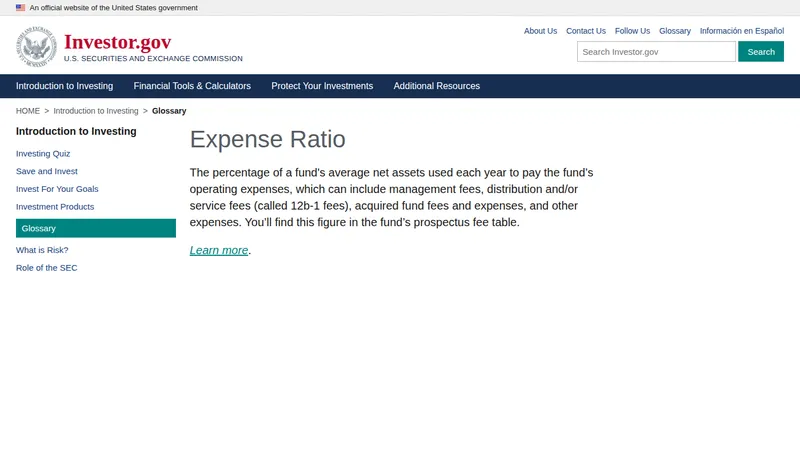
A mutual fund expense ratio is a percentage of the fund’s average net assets, not a bill that arrives in your name. It is the total of annual operating expenses — management fees, 12b-1 fees, other expenses, and any acquired-fund fees — written as a share of that pool. The fund pays those costs out of fund assets. Every share absorbs the slice. You do not get an invoice.
The prospectus splits the costs into two columns. Shareholder fees are charges you pay directly: a sales load, a redemption fee, an exchange fee, an account fee. Annual fund operating expenses are the other column — the ongoing costs of running the pool. The last line of that column is “Total Annual Fund Operating Expenses,” a percentage of average net assets. The SEC’s glossary, and the Investor Bulletin dated July 23, 2025, call that percentage the expense ratio.
What the ratio is a share of
Average net assets are the fund’s assets minus its liabilities, averaged over the year. The management fee comes out of that pool and goes to the investment adviser. A 12b-1 fee, named for the SEC rule that authorizes it, pays for marketing and sales. Other expenses cover custody, legal work, accounting, and the transfer agent. If the fund owns other funds, acquired-fund fees and expenses are added so the table shows the layer underneath.
A mutual fund has to put a standardized fee table near the front of the prospectus so two funds can be compared on the same lines. A temporary fee waiver can make this year’s ratio look smaller. The waiver can expire, or the fund can recoup the waived amount later. The table has to show that too.
The bill is taken from the pool
The fund does not send you a separate charge for the year’s operating expenses. It pays them out of fund assets — the money shareholders have already put in. The July 23, 2025 bulletin is blunt: when those fees come out of the pool, the value of the fund falls and the value of every investor’s shares falls with it. Funds deduct fees and expenses from net asset value. You pay indirectly.

That is why the ratio never shows up as a line on a brokerage confirmation the way a sales load does. A front-end load is taken from the check before shares are bought. Operating expenses are taken from the portfolio while you own the shares. The NAV you see already has the day’s slice out. An index fund still has this bill. The index itself does not.
A money market fund is a mutual fund, so it has an expense ratio too. The 7-day yield it quotes is after expenses. That yield is not a bank APY.
The ratio is also not a complete bill. What the fund pays when it buys and sells the securities it holds is not in it. Neither are brokerage commissions you pay to buy the shares, wrap-account fees, or costs tied to securities lending. No-load is a different claim: no sales load. It is not a claim of no operating expenses.
Why two similar funds finish differently
Two funds can hold similar securities and still deliver different net returns because they do not take the same slice. Share classes of one mutual fund can invest in the same portfolio and still publish different operating expenses and different sales loads. The July 23, 2025 bulletin says that owning a different class of the same fund may result in different investment returns. The holdings did not change. The fee stack did.

Even without share classes, two products with the same idea in the name can differ on management fees, 12b-1 fees, and other expenses. A higher-cost fund has to outperform the cheaper one by the fee gap just to leave you in the same place. The SEC’s July 23, 2025 illustration starts with a hypothetical $100,000 that grows 4 percent a year for 20 years. At a 0.25 percent annual fee the pile is about $208,000; at 0.50 percent, about $198,000; at 1.00 percent, about $179,000. Those are labeled hypotheticals, not forecasts. The only thing that moved was the ratio.

A waiver can hide that gap for a year. Acquired-fund fees can open it again in a fund of funds. Sampling, trading, and taxes can move returns even when the published ratios match. The expense ratio is the operating-cost line. It is not a promise that two similar names will finish even.

Read the prospectus fee table for the share class you actually hold. Confirm the current figures with the fund and with the SEC materials that publish them. This is a description of the mechanism, not a recommendation to buy or sell any fund.