A high-yield savings account is a bank deposit. A money market fund is a mutual fund. The names sit near each other on a rate table. The legal objects do not. One is a claim on an insured depository institution. The other is shares in an SEC-regulated investment company that holds short-term debt.

The confusion is mostly branding. Both products are sold as a place to park cash and both quote a yield that moves when short-term rates move. That is enough for a rate table to treat them as cousins. Underneath, one is a deposit contract. The other is a security. The protection, the price, and the way you get the money out all follow from that.
A savings account — including one marketed as high-yield — is a deposit product. At an FDIC-insured bank, the FDIC insures deposit accounts, including savings accounts and money market deposit accounts, up to $250,000 per depositor, per insured bank, per ownership category (as of August 21, 2026). At a federally insured credit union, the National Credit Union Administration’s Share Insurance Fund covers share accounts on the same dollar limit. Mutual fund shares are not in that list. The FDIC says so in plain terms.
The fund owns the paper. You own the shares.
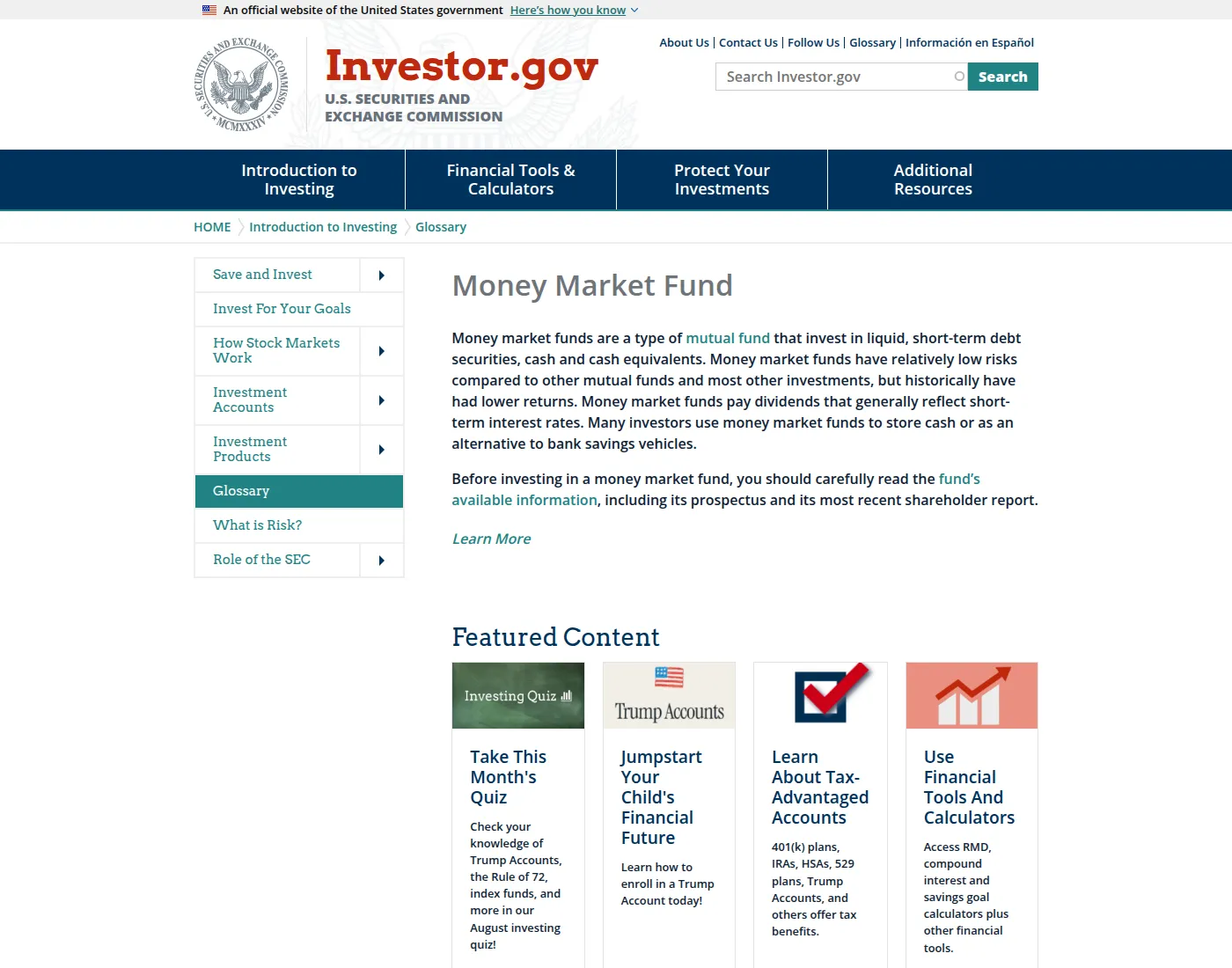
A money market fund is a type of mutual fund. It invests in liquid, short-term debt securities, cash, and cash equivalents. The SEC’s investor bulletin, dated November 4, 2024, is the official description. You own shares. The fund owns the paper. Dividends generally reflect short-term interest rates. The yield moves when those rates move. Many people use the fund as a place to hold cash. That use does not turn the shares into a deposit. It just means the shares are being used the way a deposit is used.

Like other mutual funds, a money market fund is redeemable on a business day at net asset value per share. Most retail funds and government money market funds seek a stable $1.00 NAV. Institutional prime and institutional tax-exempt funds must float their NAV. Government funds invest 99.5 percent or more of assets in cash, government securities, and fully collateralized government repurchase agreements. Prime funds hold more corporate and bank paper. None of that is deposit insurance. A stable dollar NAV is a pricing convention the fund is trying to keep. It is not a floor the government promises.
The name that is not the fund
A money market account — a money market deposit account, or MMDA — is a bank product. The FDIC insures it as a deposit. A money market fund is not that account. The SEC repeats the distinction: similar names, different objects. A brokerage screen that shows a cash balance in fund shares is showing a security, not an insured savings ledger. The word “cash” on that screen is a convenience label.

The yield numbers are not interchangeable either. A bank quotes an annual percentage yield, or APY: under federal Truth in Savings rules, a percentage rate that reflects the total amount of interest paid on an account, based on the interest rate and the frequency of compounding for a 365-day period. A money market fund quotes a 7-day yield. Form N-1A annualizes the last seven days of net income on a hypothetical one-share account, times 365/7. Both figures are standardized. They answer different questions. Comparing them as if they were the same formula is how a rate table lies by omission.
Access follows the object. A savings deposit is withdrawn at the bank or credit union under the account agreement. Fund shares are redeemed with the fund, generally on a business day, at the NAV it calculates. In market stress, some money market funds can charge a liquidity fee on redemptions. That is a fund rule, not a bank hold.

What the share is not
Owning money market fund shares is not the same as holding an FDIC- or NCUA-insured deposit. The SEC states that money invested in a money market fund is not guaranteed by the FDIC, and that there is a risk of losing some or all of the money invested. A stable $1.00 NAV is a pricing convention, not a floor. Confirm the current insurance limit and the fund’s own prospectus with the agency or the issuer that publishes them.